
The Student’s Building
Humans have built the most beautiful cities in history. Hebrews 11:10 says God looked at all of them and decided to build one Himself.

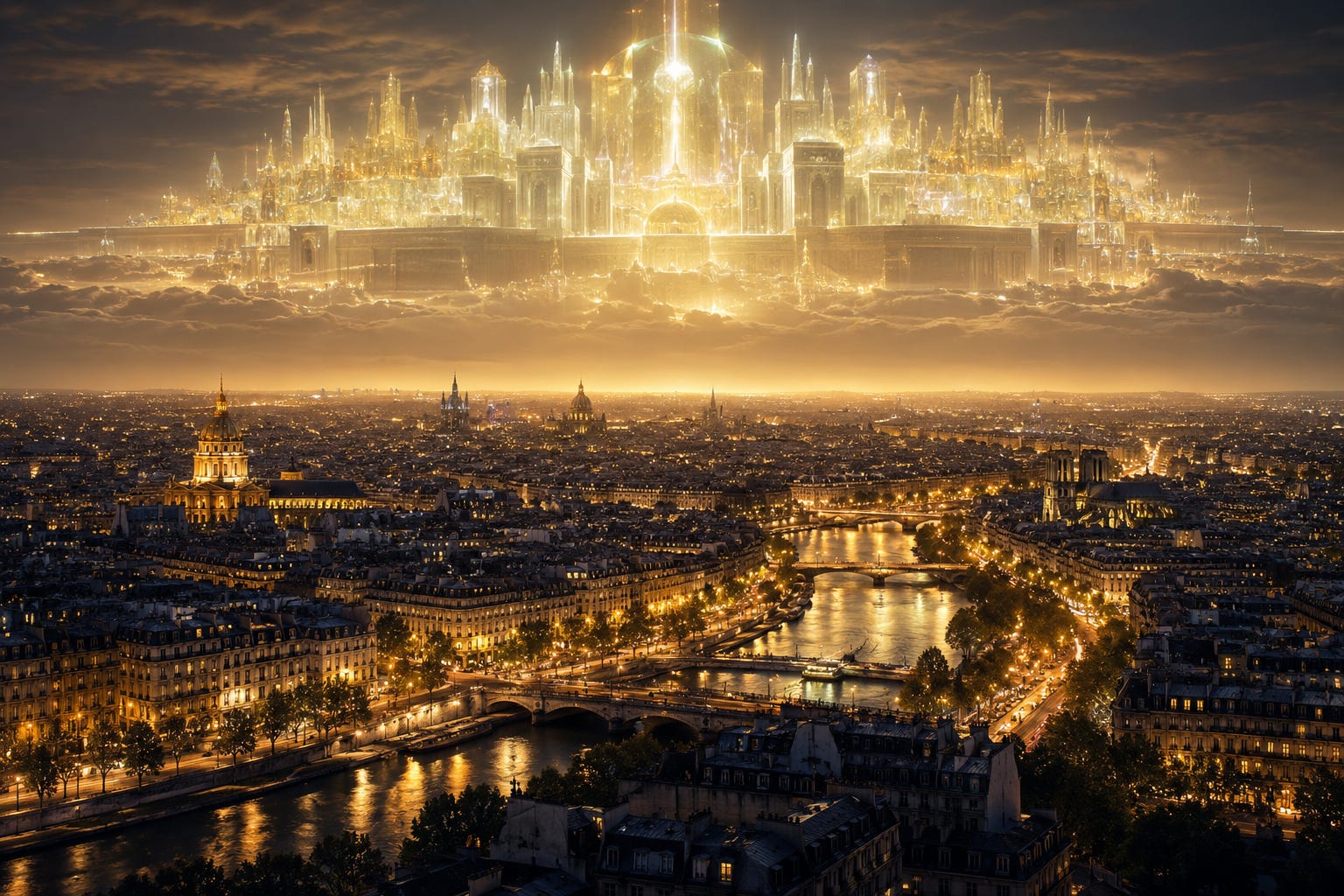
I was eighteen years old the first time I walked through New York.
I remember the specific quality of disorientation. Not confusion, disorientation. The canyon geometry of Midtown pressing down on you from both sides, the density of human energy compressed into an island and forced upward by sheer necessity into something that became, against all logic, sublime. I had read about it. I was not prepared for it. There is a difference between knowing a city is great and standing inside its greatness and feeling it reorganise your sense of what human beings are capable of.
I have since lived in Paris. Which does something different to you entirely. Paris is not vertical ambition. Paris is accumulated centuries of aesthetic judgment, Haussmann’s boulevards designed so every long street terminates in something worth looking at, the weight of stone on every facade in the 7th, boulangeries at seven in the morning with the smell arriving before the door opens. New York announces itself. Paris rewards the person willing to simply walk without a destination.
These cities are not accidents. They are the output of human civilisation operating at the height of its capacity, the image of God expressing itself through human hands across centuries of accumulated intelligence, ambition, and aesthetic judgment all directed toward a single project.
I have been studying Hebrews 11 this week, and verse 10 opened in a way it never had before. And I have not been able to close it since.
The Theology of How Things Get Built
There is a distinction in classical theology between primary causation and secondary causation, and it is the key that unlocks what the author of Hebrews is doing in three lines about Abraham.
When humans build Paris or New York, God is the primary cause at a distance. He established the physical laws that make stone stable. He designed the cognitive architecture that allows human beings to perceive beauty, make aesthetic judgments, and execute them across generations. He embedded the raw materials in the earth. Every cathedral, every skyline, every boulevard that ever stopped a person in their tracks is the output of secondary causation. God at the back, human hands at the front. His fingerprints on it the way a master’s fingerprints are on a student’s work. Foundational, generative, present throughout. But mediated.
This is true of every human city ever built. The most beautiful things civilisation has ever produced are the image of God expressing itself through creatures He made in His likeness and endowed with the capacity to sub-create.
We have done extraordinary things with that endowment.
Now read Hebrews 11:10.
What Abraham Was Actually Looking For
Abraham lived in the Promised Land as a nomad. He never owned it in any meaningful sense, purchasing only a burial plot at the end of his life. He walked through the greatest cities of the ancient Near East, traded in them, knew what the best of human building looked like. And the author of Hebrews says he was looking for something else entirely.
For he was looking forward to the city that has foundations, whose designer and builder is God.
The Greek will not let you move past this quickly. The author reaches for two words. Τεχνίτης; craftsman, skilled artisan, the one who works with his hands and his expertise to bring something into existence. Δημιουργός; sovereign architect, the one who conceives the whole from nothing and determines its form before a single element is placed. God is both. The craftsman and the architect. No secondary cause between the conception and the result. No human contractor. No accumulated civilisational knowledge being applied to a divine brief. No mediation of any kind.
He was waiting for God to compete.
Babel and the Human Project
Before we get to what God builds, it is worth naming what humanity has always been building toward. Because Babel is the most honest statement of the human civilisational project in its fallen form, and it runs as a shadow underneath every great city ever constructed.
Come, let us build a city with its top in the heavens. Let us make a name for ourselves.
Not that humans build badly. They build extraordinarily well. The impulse to build is the image of God in its most visible form. But in its fallen register, that impulse is directed toward human glory, human name, human heaven of human construction. The tower was not stupidity. It was supreme human confidence. We can close the distance between what we are and what God is through the accumulation of enough human effort and collective will.
God’s answer to Babel is not a counterargument. It is a counter-construction. And it arrives not by dismantling human building but by doing something human hands are structurally incapable of: building a city not from the outside in, but from the inside out. Not a city filled with His glory. A city made of it.
When the Source Builds Directly
Revelation 21 attempts to describe what this looks like. The language visibly strains.
John reaches for the most extreme materials human imagination has available. Pure gold like clear glass. Foundations of precious stone. Gates that are single pearls. The dimensions staggering in scale, beyond any city human architects have ever conceived.
But the details are not the point. Two details are the point.
There is no temple in the city. Because God is its temple. There is no sun. Because God is its light.
Sit with what that means structurally. In every human city, the sacred space is a building within the city. In every human city, the light source is a created thing embedded in the infrastructure. The presence is housed somewhere inside the city. The light is installed.
In the city of Hebrews 11:10, the presence is not housed inside it. The city is built out of the presence. The illumination is not a feature of the architecture. The illumination is the One who built it, and His being there is the city’s light in the same way that a fire’s being there is the fire’s warmth. Inseparable. Not a property added to the structure. The structure itself.
This is what no human city can ever be. New York is magnificent because of what is in it and around it. Paris is beautiful because of what is on it and through it. The eschatological city is beautiful because of what it is. Human architecture arranges external materials into beautiful forms. Divine architecture externalises glory itself. The beauty is not applied to the structure.
The beauty is the structure.
And this means the architect and the building are, in the most literal sense, one. God did not build a city and then fill it with His glory the way humans build cathedrals and fill them with stained glass and centuries of accumulated prayer. He built the city out of His glory directly, the way a human body is not a container for a person but is the person. The city does not point toward God the way Notre Dame points toward God. The city is the presence, given architectural form.
That is what Abraham was looking for. Not a better city. A city in a different ontological category altogether. One where the distinction between the building and the builder has finally, permanently collapsed.
The Laughter of Disproportion
Psalm 2:4 says “He who sits in the heavens laughs”.
Not in contempt but in disproportion.
The laughter of infinite creative capacity watching its finest students work at the absolute outer edge of what borrowed materials and borrowed intelligence can produce. The student’s work is genuinely impressive by student standards. That is precisely what makes the laughter appropriate. It is not the laughter of a person watching something bad. It is the laughter of a master watching something good that has not yet understood its own smallness relative to what the master could do.
I stood in New York at eighteen and felt the city reorganise my sense of what human beings are capable of.
I think about what it would mean to stand in the city with foundations and feel the same reorganisation. Not of what human beings can do. Of what God is. The city is not evidence of divine capability the way Paris is evidence of human capability. The city is divine capability, expressed without delegation, without the scaffolding of secondary causation, without anything held back.
The competition was always real. The outcome was never in doubt.
What Abraham Understood That We Have Not Yet Seen
Come back to Abraham in the tent.
He had seen the cities. He knew what human building looked like at its best. And Hebrews reads the logic of his life as permanently oriented past all of it toward something else. Not a city where the governance is better and the architecture more elegant. Something in a different category. Something built without the mediation of human hands. Something where the question of where the city ends and God begins does not arise, because the city is the answer to that question.
He called himself a stranger in every city human hands had built and spent his life walking toward the one that wasn’t.
I do not have language for what that city fully looks like. Revelation 21 tries and the words buckle under the attempt. But this much is clear: if God looked at the greatest things human civilisation has ever produced and laughed the laughter of disproportion, then what He built with nothing held back, working as craftsman and architect simultaneously, externalising glory itself into architectural form, is not something human imagination can approach from the front.
You have to come at it from the side. You have to let the best thing you have ever seen, the moment where human civilisation most stopped your breath, stand as the floor. The entry point to the category. The baseline against which the comparison is being drawn.
The city with foundations is to Paris what Paris is to a child’s drawing of a house.
Abraham saw it from a distance, called himself a stranger in every city human hands had built, and spent his life walking toward it.
He was right to.