
The Harder Case
Abraham is the father of faith. Noah is what faith looks like with nothing left to hold onto.

Verse 7 of Hebrews 11 is two sentences. Most readers are through it in seconds, already moving toward Abraham. I have read it that way for years. This weekend, it stopped me entirely.
The Hall of Faith is the most famous passage in the book of Hebrews and one of the most famous in the New Testament. The author marshals figure after figure to demonstrate that believing God against visible evidence is not a novel posture invented by the early church. It is the operating mode of the entire history of God’s people. Abraham gets the most real estate. He is rightly revered, rightly called the father of faith. His story dominates the chapter. But verse 7 is three lines about Noah, and this time those three lines would not let me go.
Because when you actually do the arithmetic on Noah’s life, something becomes clear that I had spent years reading past.
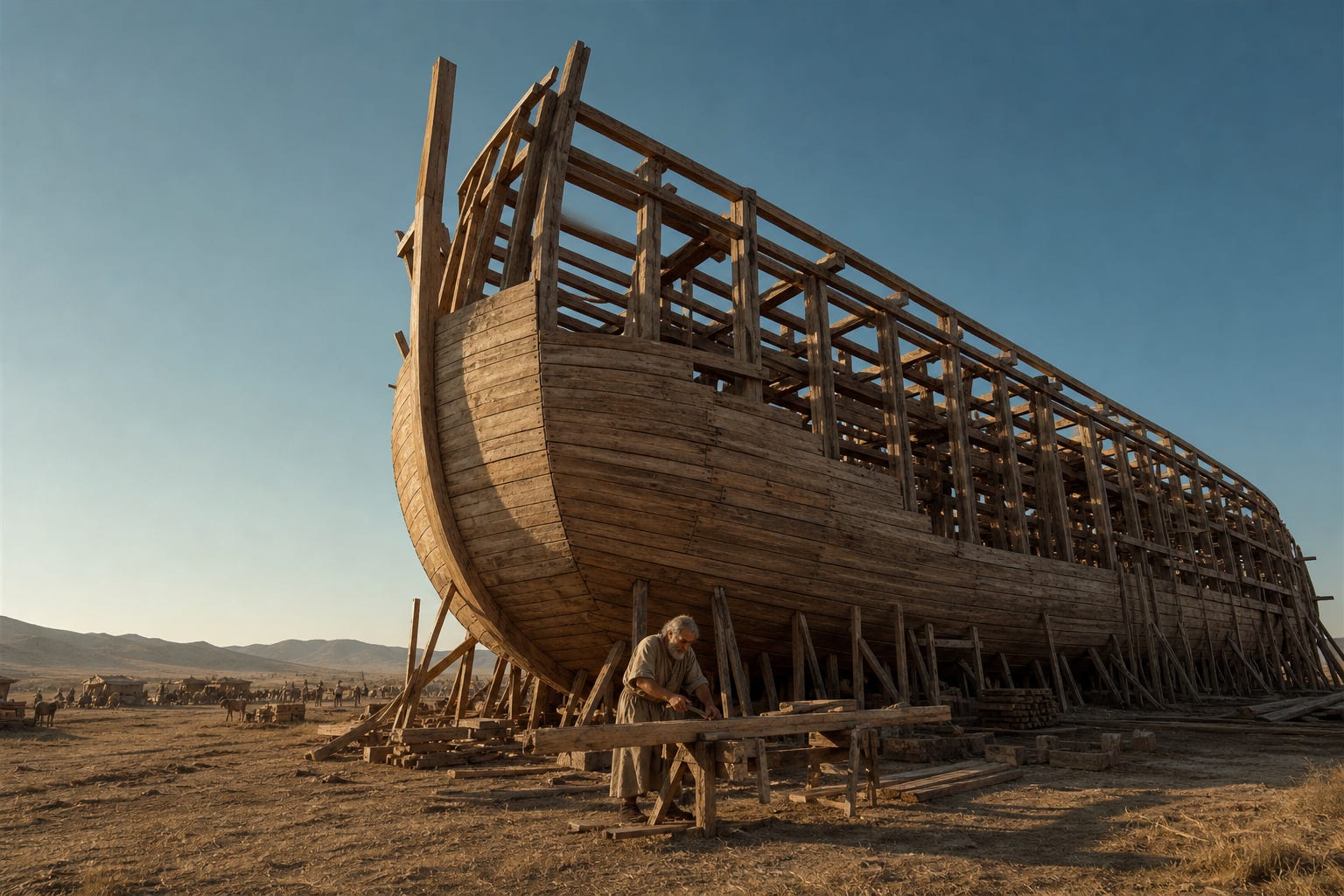
This man built the ark across decades.
Genesis tells you that Noah was 500 years old when his sons were born, and 600 years old when the flood came. The construction window was somewhere between decades and a century. Some traditions, reading Genesis 6:3’s warning period as the timeline God granted before judgment, hold the figure at 120 years. Whether the true number is 50 or 100 or 120, the point is the same, and it is staggering. This is not a man who received a word from God and saw its fulfillment within the normal horizon of human expectation. He received a word and went to work, and the sky stayed the same for as long as some nations have existed.
And then I sat with the comparison that the chapter is implicitly drawing, and the full weight of it landed on me for the first time.
What Abraham Was Waiting For
Abraham waited for a blessing: a land, a seed, a city. The content of the promise was inherently desirable. There was something to want, something to orient desire toward across the years of apparent delay. The thing being waited for was a gift. His faith had emotional fuel in a way that is easy to underestimate: hope, in its most natural form, is forward-looking desire. And Abraham had something worth desiring to keep him oriented forward.
But the author of Hebrews adds something else about Abraham that almost everyone reads past. Verse 13 tells us that the patriarchs “died in faith, not having received the promises,” but this is the outer frame of Abraham’s story. Inside that frame, the experience of waiting was punctuated by something remarkable. Genesis 15 gives you the stars-and-sand vision, God taking Abraham outside and saying look up, count them if you can, so shall your offspring be. Genesis 17 gives you the covenant of circumcision, a name change, and the explicit restatement of the promise. And then Genesis 18 gives you something that should stop every reader entirely: God comes down to Abraham. Not in a dream. Not in a vision. He appears in the heat of the day, three visitors at the tent, and Abraham runs to meet them, slaughters a calf, brings curds and milk and the meat, and sets it before them. God sits down at Abraham’s table. He eats Abraham’s food. He stays long enough for a conversation, long enough for Sarah to overhear and laugh, long enough to restate the promise one more time by name and by timeline: at this time next year, Sarah will have a son.
Think about what that is as a mechanism for sustaining faith. The God whose promise you are waiting on visits your home. Sits in your space. Shares a meal. Speaks the promise again out loud, in your hearing, in your lifetime. Whatever the difficulty of the waiting, Abraham had this. He had periodic reinforcement. He had covenant signs. He had the visitation. His faith was stretched across years and genuinely tested, but God kept coming back to speak.
What Noah Was Waiting For
Noah was waiting for the end of the world.
Let that land before moving forward. The object of Noah’s faith was not a blessing held out in the distance. It was not a land he would inherit or offspring he would father or a city being prepared for him. The thing his faith was oriented toward, the event the ark was being built to survive, was the annihilation of everything around him. Every plank he drove was a declaration that everyone he had ever known outside his immediate family was going to die. He was not building toward his inheritance. He was building toward history’s first apocalypse, and the only thing separating him from the bodies he would eventually float above was his belief in a word that nobody else believed.
The sky was unchanged. The rivers ran normally. The people around him were doing what people do. Genesis 6 and Matthew 24 give you the same description: eating and drinking and marrying and giving in marriage, the ordinary texture of life, uninterrupted. Every morning without rain was, from any reasonable epistemic standpoint, a quiet vote against Noah’s project. And 2 Peter 2:5 calls him a preacher of righteousness, which means everyone in his world knew what he believed and watched him act on it for a lifetime, with no vindication coming.
Scripture records no reinforcement during the construction period. No mid-project confirmation. No covenant ceremony. No divine visitor sitting down at his table to eat with him and restate the promise. No stars to count, no new name, no sign in the sky. The commission of Genesis 6 is the word he had. The text moves from commission to compliance with no recorded interruption. He heard, and he built, and the decades turned, and the sky stayed blue.
What Sustained Him
The author of Hebrews does not leave the sustaining mechanism unnamed. He gives it in one word. Not hope, not vision, not the anticipation of reward. Εὐλαβηθείς. Moved with godly fear. Moved with reverence.
This word is consistently flattened in translation and almost always under-read in exposition. Godly fear in its mature biblical form is not punishment avoidance. It is not the cramped, reactive compliance of a man trying to stay out of trouble. The eulabeia word group in the New Testament carries the sense of careful, attentive, whole-person orientation toward the reality of God, a responsive disposition in which the weight of who God is presses on the soul with enough force that obedience becomes the only coherent response to existence. Not because the outcome being obeyed toward is attractive. Because the God commanding it is real.
Most accounts of persevering faith locate the energy of perseverance in vision, in keeping the end goal in view, in hope as forward-looking emotional fuel. Noah cannot use that structure. The flood is not a moment worth imagining toward. Floating above the bodies of everyone you have ever known outside your family is not a scene that generates desire.
What Noah had instead was entirely backward-facing. Not the attractiveness of what was spoken, but the absolute reliability of the One who spoke. The sustaining power was not located in the future. It was located in the character of God, His truthfulness, His authority, His sovereignty over history, pressing on Noah’s soul across decades with enough mass that compliance needed no additional justification. He built because God said there would be a flood. God does not lie. Therefore, there will be a flood. Therefore, he would build. The logic was simple. The execution was a century.
The Absence of Feedback Loops
Here is what makes Noah’s faith perhaps the purest demonstration of the definition in verse 1: faith is the substance of things hoped for, the evidence of things not seen.
Every figure in the chapter inhabits this definition. But most of them received progressive evidence along the way, in the form of repeated divine speech, confirming visions, covenant signs, and the lived accumulation of God’s faithfulness over time. Abraham had all of this. Even the others in the chapter, Isaac’s blessing in prophetic confidence, Jacob’s worship at the end of his life, Joseph’s instruction about his bones, had lifetimes of demonstrated divine faithfulness behind their final acts of faith. The evidence of things not seen was, for them, partially provided by things that had already been seen.
Noah had none of this architecture available. Scripture records one word, and then silence on God’s part until the flood arrives. The evidence of things not seen was nothing visible. Just the word. For a century. With tools in his hands and an unchanged sky above him.
This is godly fear doing what nothing else can do. When hope cannot sustain you because the object of the promise is a judgment rather than a gift, when confirmation cannot sustain you because the record shows none coming, when social reinforcement cannot sustain you because the entire world thinks you have lost your mind, the only thing left is the weight of God Himself, pressing on you with enough force to keep you moving in the absence of every other mechanism that normally keeps people moving.
What He Condemned Without Trying To
Hebrews 11:7 makes a claim about Noah that is easy to read past: by which he condemned the world.
Not by his preaching primarily. By his staying.
Every day Noah continued to build was a verdict on everyone who did not. He had no prosecutorial intent. He was simply complying with a word he had received from a God he feared. But sustained compliance with God’s word is always an implicit judgment on those who heard the same word and chose otherwise. Noah’s persistence, decade after decade, unchanged sky, no confirmation, full social cost, was itself the prosecutorial case against the world’s unbelief. The case was not made in the argument. It was made in carpentry.
The building stood in the field. The building was the sermon. The building said, every morning it was still there and still growing: someone believed the word. Someone has taken the word seriously enough to reorganize a life around it. Someone has decided that the God who spoke is more reliable than the sky that has not yet changed.
That is a very loud sermon. Delivered in silence, over a century, in the shape of a boat.
The Question That Remains
Most of what we call sustaining faith is actually sustained by feedback. By fruit, by progressive confirmation, by circumstances that periodically validate the direction we have chosen. We talk about faith, but much of what we are describing is faith assisted by evidence, and there is nothing wrong with that. God gives confirmations. God sends visitors to Abraham’s tent. God restates the promise. He is generous with His people in the long seasons of waiting.
But Noah is the test case for what faith is when you strip all of that away.
Hebrews 11:7 has one answer to what remains. The weight of God. The reality of who He is, pressing on the soul with enough force that building becomes the only coherent response to existence, regardless of what is being confirmed and regardless of what is coming.
The flood arrived on the six hundredth year, second month, seventeenth day. Right on time. Not early, not as a mercy to Noah’s endurance, but on time, which is to say, according to the word that had been given.
The word had always been enough. The word was always the only thing that was ever going to be enough.
That is the question Noah’s life closes on every reader with: not whether you can believe when God speaks clearly, confirms repeatedly, and comes down to eat at your table. But whether you can keep building when Scripture records nothing but silence, the sky is unchanged, and the original word is all you have left.
Abraham is the father of faith. His story deserves every verse the chapter gives it. But if you want to see faith operating in its most stripped-down form, no feedback, no milestones, no divine dinner guest, no confirmed timeline, just the word and the tools and the unchanged sky, then Noah is the case. And the century of carpentry is the answer to every question about what godly fear actually looks like when it has to stand alone.
What a striking Opening statement. Hmm. Very true. Increase my faith, Lord, when there's nothing to hold on to.