
Far Inside the House
HOW TO BE ANGRY WITH GOD

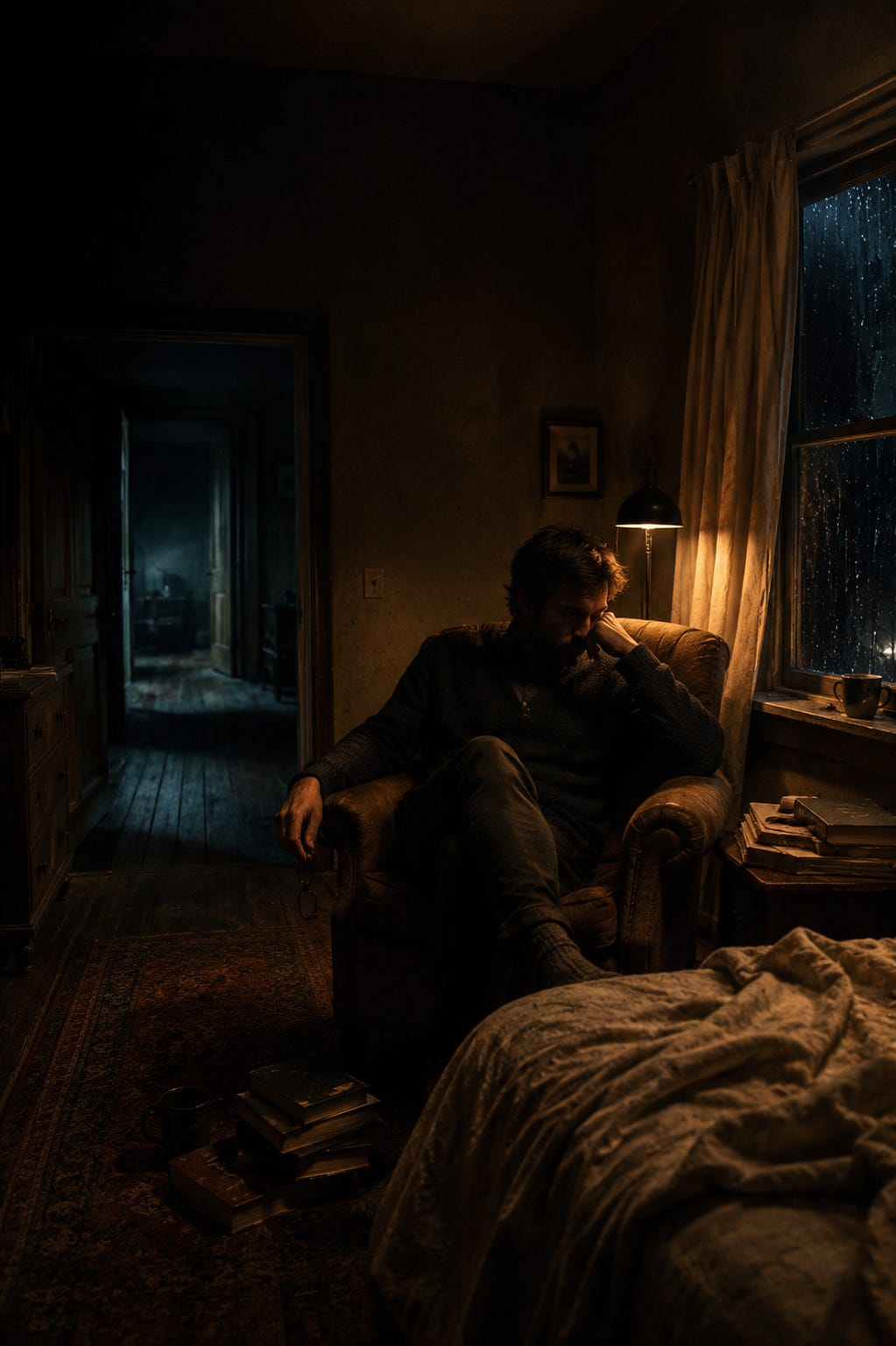
There is a kind of religious instruction that arrives wearing the face of comfort but is in fact a form of management. It says: it is okay to be angry with God. And the person receiving it is meant to feel unlocked, released, granted something they did not have. But the instruction is thin because it begins in the wrong place. It assumes the primary obstacle to holy anger is guilt, that what the wounded person needs is permission. It does not ask the more difficult question; not whether one may be angry, but from where, and in what posture, and toward what end.
This is that question.
The consequence of genuine relation is the full spectrum of emotions. This is not a pastoral observation, it is a logical one. God did not request performance. He demanded love, pure genuine inward love, and nothing less. And a God who demands that fully understands what it comes with. Love carries grief. It carries fury and silence and the long nights of waiting for an answer that does not come in the form you expected. Anyone who has loved with their whole self and been devastated by what happened to the thing they loved knows this is not a malfunction. It is what love does. It is what love is.
The demand was therefore an informed one. God was not naive about the terms.
The architecture of scripture confirms this. John writes that one cannot love the God they cannot see while failing to love the neighbour they can. The relational logic is not one-directional. If the love of God and the love of neighbour orbit from the same source and operate by the same grammar, then whatever is true of genuine love between persons is necessarily true of genuine love toward God. He has not requested an exception for himself.
Jesus in the Sermon on the Mount tells his listeners that if they are bringing their offering to the altar and remember there that their brother has something against them, they should leave the offering, go and be reconciled, and then return to worship. God will wait. The altar will hold. The unresolved relation is the more urgent matter. What this reveals about how God has structured the life of faith is not incidental. He has built a theology that takes the weight of unresolved feeling seriously enough to pause worship for it.
This is not a God who wants the performance without the person inside it.
THE RIGHT POSTURE
If one is angry with God, one must be angry as one bound in love. Not angry towards the edge of the exit door of the house, but angry far inside the warmth of the bedroom, as though not planning to leave. One must sit in anger and not stand, and not just sit but sit with crossed legs, as though understanding the certainty of resolution.
The binding is not a feeling. It does not arrive with the anger or depend on it. It is the premise the anger stands on. And the geometry of the image carries the whole argument: the difference between the doorway and the bedroom is the difference between an anger interrogating the relationship and an anger still inside it. Both are angry. Only one is faithful.
The crossed legs are an essential detail. Sitting already signals non-departure. But crossed legs signal something further, ease within settledness. You do not sit that way in a place you are about to leave. You do not sit that way in formal confrontation. It is the posture of someone who belongs in the room and has not forgotten it, not even now.
But what is the certainty of resolution?
There is a condition for which there may not yet be a sufficient name. You look back at something you wrote, something you were convinced of and argued for with the full force of your intelligence, and you see with clarity that you were wrong, not even interestingly wrong, but wrong in a way that is faintly embarrassing. And you understand in that moment not only that you were wrong then, but that this will happen again. That you currently hold convictions with the same force and the same confidence, and some of them are mistaken in ways your present self is structurally unable to detect. The limitation is not a failure of effort. It is the condition of being bound inside time, inside a particular vantage point, inside a mind that can only see from where it is standing.
To be bound inside time is to have only partial sight, always. And to bring your anger about God to a God who exists outside of it entirely is to bring it to one who does not simply see further down the same river you are standing in. He is not in the river. He does not see the resolution after the wound, or before it, or even alongside it. He simply sees the whole thing, timelessly, at once. Not because he waited for clarity to arrive, but because sequence; before, during, after does not govern him. He has no hindsight because hindsight is a faculty of creatures caught inside time. He has only sight.
The certainty of resolution that belongs to the person sitting cross-legged in the bedroom is not certainty that their understanding of the situation is correct. It is certainty that the one they are angry with is not bound by the same limitation. It is faith in the competence of God, which is a different and more demanding thing than confidence in your own position.
The anger is therefore not only emotionally legitimate. It is epistemically humble. You are sitting inside the grievance, inside the wound, inside the full force of what you feel; as someone who knows they may not be seeing clearly, trusting the one who sees completely. You are not waiting for God to agree with you. You are waiting for the resolution that exists beyond what you can currently see.
You are doing this from inside the house, with your legs crossed, with no intention of leaving.
That is what faithfulness looks like when it is in pain.